When Your Vietnam Cosmetics Tin Box Supplier Goes Silent: A Buyer's Recovery Plan
A silent supplier is a documentation problem before it becomes a supply problem. When a Vietnam cosmetics tin box supplier stops answering in the middle of an active order — artwork approved, deposit paid, delivery date agreed — the recovery plan should start within roughly 48 hours, not after the promised ship date has passed. The sequence that protects a launch is: confirm what you own, escalate on parallel channels with a written deadline, build one timeline file, and open a parallel quotation track so a priced alternative always exists.
This plan is written for beauty brands, OEM buyers, packaging managers and importers who are already mid-project and need a structured way out. It covers the warning signs that appear before total silence, a follow-up cadence that creates a paper trail, the specification pack a replacement supplier needs, and the decision rules that separate waiting from dual-sourcing from replacing.
What Counts as Supplier Silence — and Why It Is Urgent
Supplier silence in a custom tin box project means a decision-critical question has received no substantive answer on two or more channels within the response window stated in the purchase order or, where none is stated, within two business days. A slow reply is not silence. Silence is when the missing answer blocks a dated decision: plate or die approval, colour proof sign-off, production slot confirmation, or the shipping booking that sets the delivery date.
The urgency comes from four exposures that grow while you wait:
- Physical assets. Print plates, dies and any tooling created for your artwork may be inside the supplier's plant, and their ownership and location may never have been written down.
- Cash. A deposit paid against an unverified production status is money with no visible counterpart.
- Calendar. Cosmetic launches and gift-set programmes are tied to fixed dates; packaging that arrives late converts a packaging problem into a revenue problem.
- Information. Artwork versions, approved proofs, sample references and agreed tolerances sit with the contact who has stopped replying.
The reason to act fast is that recovery has its own lead time. A replacement supplier still needs the dieline, a print proof, a physical sample and a production slot. Every day spent waiting is added to that chain, never subtracted from it.
Why Tin Box Projects Break Down at the Communication Layer
Custom cosmetics tin boxes are produced to order, and the production chain is sequential: artwork and dieline, print proof, plate and tool making, tinplate printing, stamping and forming, curling or seaming, insert or partition assembly, then packing and export booking. Each step depends on an approval from the previous one. When the single account contact disappears, the buyer cannot see which step has stalled — and cannot tell a supplier that is running late from a supplier that has stopped.
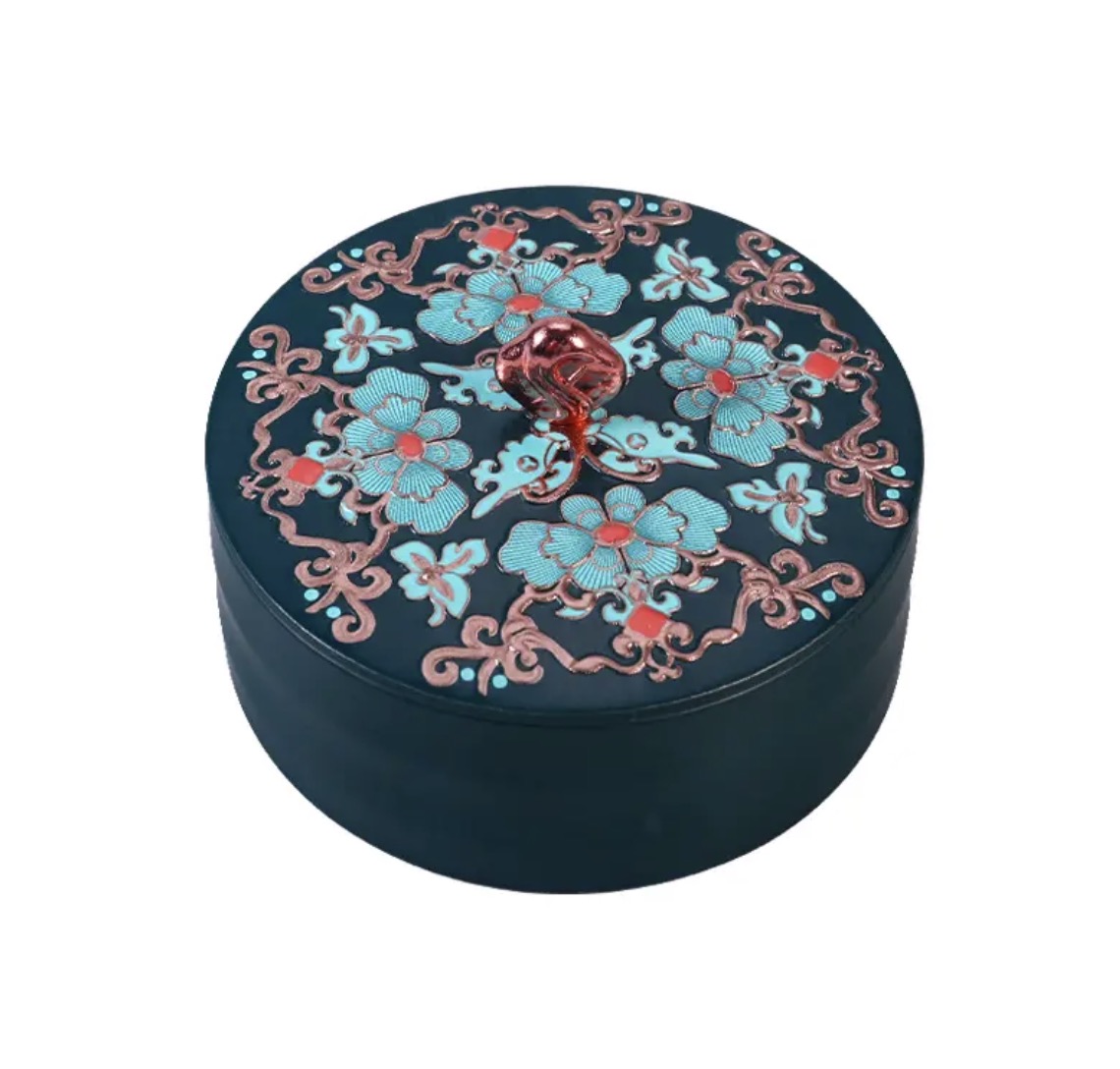
Three structural features make this pattern common in cosmetics packaging specifically. First, the formats are customised: a Vietnam lipstick cosmetics tin box, a partitioned eyeshadow tin or an airtight moisture-proof tin for essential oil all require tooling and print setup that cannot be swapped between suppliers without re-approval. Second, demand clusters around gifting seasons and launch calendars, so the same delay that is tolerable in commodity packaging is damaging here. Third, cross-border sourcing concentrates communication in one account manager across a language and time-zone gap, which removes the redundancy a domestic supplier relationship often has.
The practical conclusion is that silence is a normal operational risk, not an exceptional one. Buyers who treat it as a scenario to be planned for recover faster than buyers who treat it as a betrayal to be investigated.
Early Warning Signs Before Total Silence
Total silence rarely arrives without notice. The following signals typically appear first, and each one has a proportionate response that costs little at the time.
- Reply times stretch from hours to days, but the questions are answered. This is a capacity signal. Response: move every open point into one numbered email so the supplier cannot answer selectively.
- Answers become generic — “in production”, “will update soon” — with no dates, photos or stage names. This is a visibility signal. Response: ask for a photograph of the current stage with your artwork visible, plus the next dated milestone.
- Proof or sample approvals slip without a revised schedule. This is a planning signal. Response: request a written revised timeline covering proof, sample, mass production and shipping.
- The contact avoids a scheduled call or a factory-floor photo request. This is a confidence signal. Response: escalate to a second named contact in the same message thread.
- Bank or invoicing details change late in the project. This is a risk-control signal. Response: verify through an independent channel before any payment, and never confirm changes from a single email.
- A new name introduces itself with no handover note. This is a continuity signal. Response: resend the full project summary and ask the new contact to confirm the open points in writing.
- The forwarder has no booking, or booking happens later than agreed. This is a physical-reality signal. Response: verify shipment status directly with the forwarder rather than through the supplier.
- Questions about plate or die ownership go unanswered. This is the most serious signal. Response: treat tooling documentation as a separate, escalated request.
The First 72 Hours: A Step-by-Step Recovery Sequence
The following sequence is deliberately front-loaded. Steps 1 to 4 happen on the first working day, steps 5 to 7 within three days, and step 8 at the written deadline rather than before it.
- Write down what you actually own. Collect the editable artwork and dieline, the approved print proof, the sealed approved sample, the purchase order, the deposit receipt, the agreed delivery date, any inspection rights, and any cancellation or tooling clause. This file is the foundation of every later conversation.
- Send one consolidated message instead of a series of questions. State the project reference, the pending decisions and the date by which you need answers. Ask questions that can be answered with a yes, a no or a date — for example, whether plate making has started, and on what date it was completed.
- Escalate on parallel channels the same day. Send the same message by email to the account manager, to a second named contact, and to the company's general inbox, and follow up by phone or messaging app. After any phone call, restate the outcome in writing so the record stays complete.
- Set a written deadline and state the next step neutrally. A factual sentence works better than a threat: if no confirmation arrives by a given date, a parallel order will be placed and release of buyer-funded tooling will be requested. Neutral wording keeps the commercial relationship recoverable if the supplier returns.
- Verify physical reality through third parties. Ask the freight forwarder whether a booking exists, check with any inspection agent, and confirm with your bank whether the deposit was actually collected. Third-party confirmation separates a communication failure from a production failure.
- Open a parallel quotation track. On day two or three, request quotations and indicative dates from two or three alternative tin box suppliers using your existing dieline and reference sample. This is insurance, not a switch: it converts an unknown into a priced, dated option.
- Start one timeline file and keep it current. Record the date, channel, person, message and response for every exchange, plus payment and shipping milestones. One file, one numbering system, no scattered notes.
- Decide at the deadline. Choose between continuing, dual-sourcing, transferring tooling or restarting — using the decision rules below — instead of extending the deadline a third time.
A Follow-Up Cadence That Builds a Paper Trail
A cadence removes the daily judgement call about whether to chase again. The schedule below is a workable default for an active order with a fixed delivery date; compress it when the ship date is close.
| Timing | Channel | What to send | Purpose |
|---|---|---|---|
| Day 0 | Email to account manager plus messaging app | One consolidated message with numbered open points and a response date | Establish the record and the deadline |
| Day 2 | Email to second contact and company inbox | Same message, marked as a follow-up, with the deadline restated | Bypass a single point of failure |
| Day 5 | Phone or video call, confirmed in writing | Request for a dated stage confirmation and a photograph of production | Test whether the supplier can still evidence work |
| Day 8 | Email plus forwarder check | Notice that a parallel quotation track has started | Create commercial pressure without accusation |
| Day 12 | Email to management level | Request for tooling ownership and location confirmation | Protect buyer-funded assets before any switch |
| Day 15 | Formal written notice | Statement of the decision taken and the next required action | Close the ambiguity in writing |
Documenting Specs and Timelines So Another Supplier Can Take Over
A replacement supplier can only be fast if the specification pack is complete. The pack is the difference between a quotation in days and a technical exchange that restarts the project from zero.
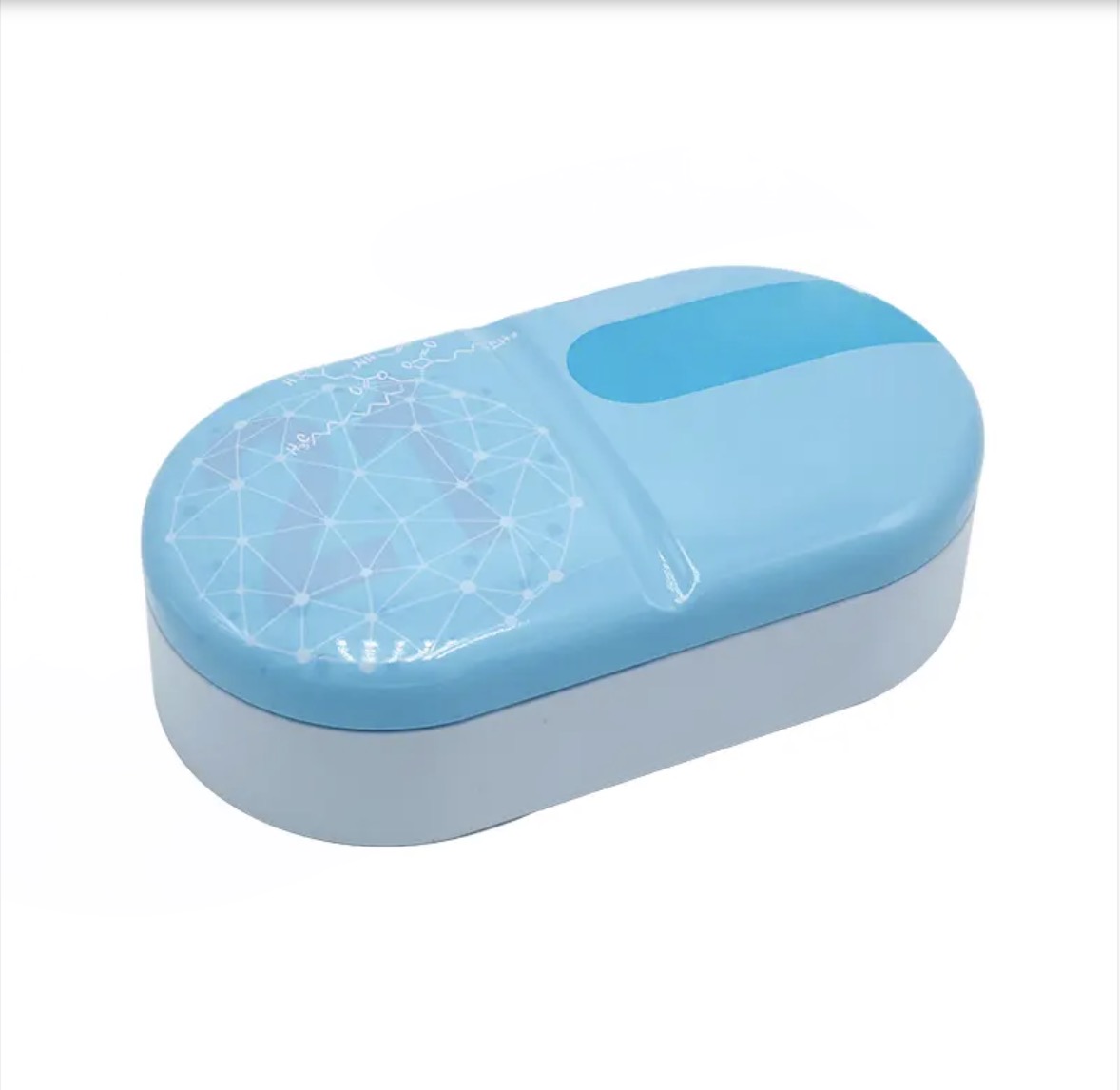
The minimum handover pack for a cosmetics tin box programme contains:
- Construction and format: round, square, rectangular, hinged lid, slip lid, window or book-style; whether the format is a lipstick cosmetics tin, an eyeshadow tin, a mini or travel-size tin, a gift-set tin, or an airtight moisture-proof tin for essential oil.
- Dimensions and tolerances: external and internal dimensions, height, lid fit and the tolerance that matters for your filling line or insert.
- Material and finish: tinplate grade and gauge as previously agreed, closure type, interior requirement, print method, colour count, varnish or finish, and any embossing or debossing.
- Artwork control: the editable file, the approved version number and date, and the approved colour proof reference.
- Assembly detail: partition layout, insert material, foam or thermoformed tray, ribbon or fitment, and how the components are packed.
- Commercial and logistics record: order quantity, packing configuration, carton marks, delivery terms, and the shipping schedule already agreed.
- Evidence record: the sealed approved sample, photographs of it from every side with a scale in frame, and the signed approval note.
- Tooling record: who funded the plates and dies, who holds them, and where they physically are.
Two habits make this pack usable under pressure. The first is a decision log — every approval, revision and confirmed date in one place, with names attached. The second is a physical reference: photographs of the approved sample next to a ruler, taken before the project ran into difficulty, because a photo taken after the fact can never be verified against the original.
Reassessing the Supplier Without Guessing
When a supplier reappears, the question is not whether the apology is convincing but whether the evidence is verifiable. Separate three things in writing: what you know from documents and third parties, what the supplier asserts, and what you still need before releasing the next payment or confirming the ship date.
A supplier that can still deliver usually demonstrates four things within a short window: a dated stage confirmation, a photograph of production carrying your artwork, a revised schedule that acknowledges the delay rather than erasing it, and a named person who answers within one business day from then on. A supplier that returns without these is not recovered — it is merely responsive.
State the reassessment criteria before the conversation, so the decision is not made by relief. Reasonable criteria include: restored and stable responsiveness, verifiable production status, clarity on tooling and its ownership, willingness to accept third-party inspection, a credible revised delivery date with buffer, and a structural fix to the single-contact problem — for example a second named contact or a shared project tracker.
Recovery Options Compared
Four options exist once silence is confirmed. They are not ranked by preference; they are ranked by what they cost and what they protect.
| Option | What it requires | Main risk | Effect on delivery date | Use when |
|---|---|---|---|---|
| Continue and wait | A credible revised schedule plus verifiable stage evidence | Silence returns after the deadline is extended | Delay equal to the extension | The supplier provides dated evidence and the launch date still holds |
| Dual-source the balance | A second supplier with the dieline, artwork and reference sample | Two colour standards and two packing specifications to manage | Partial protection; part of the quantity arrives on the original date | The original supplier is partially functional and quantity can be split |
| Transfer tooling | Written ownership confirmation and physical release of plates or dies | Tooling is undocumented, worn or held against an unpaid balance | Shorter than restart if tooling is genuinely transferable | Buyer funded the tooling and holds written confirmation |
| Restart with a new supplier | A complete specification pack and a new sample approval round | New tooling cost and a full proof-and-sample cycle | Longest single option, but predictable | Tooling cannot be released or the original supplier is unreachable |
Use Cases: How the Plan Applies to Different Cosmetics Formats
Vietnam lipstick cosmetics tin box, mid-production
A lipstick tin is usually a small-format tin with a tight lid fit and a colour-critical print. If the supplier goes silent after proof approval, the tooling and the colour standard are the assets at stake. The priority is to secure the approved proof reference and the plate ownership record before opening the parallel track, because a new supplier will otherwise re-match a colour with no benchmark.
Vietnam eyeshadow cosmetics tin box with partitioned storage
Partitioned formats carry two specifications: the tin itself and the interior layout. Silence during the assembly stage is more serious than silence during printing, because the insert may be produced by a third party the buyer never contracted with. The recovery step is to identify whether the partition component sits with the tin supplier or a sub-supplier, and to document the layout drawing so a replacement can quote the assembly, not just the tin.
Vietnam travel size or mini cosmetics tin box pilot order
Pilot and travel-size orders are typically small in quantity but still require tooling and print setup, which makes them the easiest orders for a supplier to deprioritise. When the pilot goes silent, the buyer's leverage is the follow-on volume, stated plainly in the escalation message. The parallel track should quote both the pilot quantity and the planned follow-on quantity so the comparison is realistic.
Vietnam gift set cosmetics tin box against a fixed launch date
Gift-set programmes have the least scheduling flexibility, because the tin usually carries the assembly of several items. Here the decision rules tighten: if the supplier cannot produce dated stage evidence by the first written deadline, dual-sourcing or restarting should begin immediately rather than after a second extension, and the assembly plan should be re-timed together with the tin, not separately.
What to Verify in a Replacement Vietnam Cosmetics Tin Box Supplier
A replacement is only a recovery if the second supplier can be verified faster than the first one failed. Five checks matter more than a catalogue: whether cosmetics tin boxes are genuinely within the manufacturer's production scope, whether design, shape and printing can be customised to an existing dieline, how quality control is documented at each stage, how buyer-supplied artwork and tooling are handled, and whether more than one named contact will manage the project.
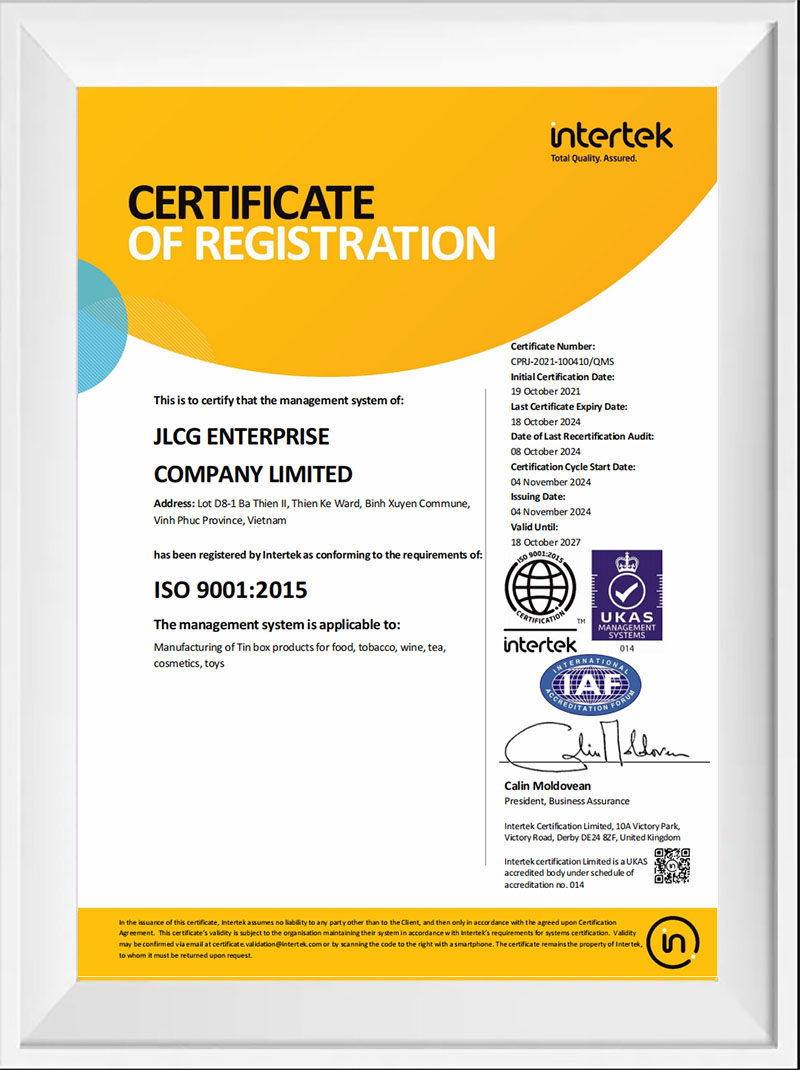
JLCG Enterprise Co.,Ltd is a tin box manufacturer based at Lot D8-1 Ba Thien ll Industrial Park, Thien Ke Commune, Binh Xuyen District, Vinh Phuc Province, Vietnam, with more than 25 years of experience in the design, production and customisation of tin packaging for food, gifts, cosmetics and collectibles. The company offers full customisation of design, shape and printing, follows documented quality control processes, holds ISO 9001:2015 certification, and applies eco-friendly practices across material sourcing and waste management. For a buyer recovering from a stalled order, the relevant capability is that a project can be reviewed from an existing specification pack — dieline, artwork and approved reference sample — rather than rebuilt from a verbal description.
Frequently Asked Questions
If a Vietnam cosmetics tin box supplier goes silent, who owns the print plates and dies?
Ownership is decided by the purchase order and any tooling clause attached to it, not by who is physically holding the plates. Where the buyer funded the plates or dies, the buyer normally has a claim to them, but that claim is only usable if it was written down. The practical step is to request written confirmation of tooling ownership and physical location before the project stalls completely. Without that confirmation, a replacement project usually has to budget new tooling and a new print proof.
How can I tell whether a silent supplier can still finish my order?
Ask for evidence that carries a date rather than for reassurance. A supplier that can still deliver is usually able to send a stage confirmation, a photograph of printed sheets showing your artwork, a revised production schedule with dates, and a named person who answers within one business day. If none of these arrive by the written deadline, treat the capacity as unavailable and move to the parallel track. Verbal promises without dates are not evidence of capability.
What does replacing a Vietnam cosmetics tin box supplier mid-project cost?
The cost typically comes from four places: new tooling or print plates if the originals cannot be transferred, a new sample round, duplicate or expedited freight, and the commercial value of the delay itself. Buyers control it by comparing those items against the cost of a late launch and by securing tooling ownership in writing at the start. A dual-source approach, leaving part of the quantity with the original supplier while a second supplier proves capability, often costs less than a full restart.
Do I need to re-approve samples with a replacement supplier?
Yes. A replacement supplier builds its own tooling and print setup, so a new physical sample has to be approved against the original approved reference rather than against a photograph. Keep the sealed approved sample, photograph it from every side with a scale, and send it to the new supplier as the standard. The signed sample approval record is also what protects you if the second supplier's output later drifts from the approved colour or construction.
How quickly can a replacement supplier take over a stalled cosmetics tin box order?
It depends on three things: whether the artwork and dieline exist in editable form, whether tooling can be transferred, and whether the format is standard or fully custom. A supplier that can quote directly from an existing dieline and a reference sample shortens the process the most, because the print proof and sample loop can start immediately instead of after a design phase. JLCG Enterprise Co.,Ltd produces custom cosmetics tin boxes in Vietnam and can review a stalled project from an existing specification pack; samples and quotations can be requested through sales06@vntinbox.com or +86 18819080997.
Conclusion
Suppliers go silent for ordinary reasons — capacity pressure, a tooling problem, a commercial reassessment or an internal disruption — and the buyers who recover fastest are the ones who prepared for the possibility before it happened. The plan in this article reduces to four habits: know what you own, escalate in parallel with written deadlines, keep one timeline file and one specification pack, and always hold a priced alternative from a parallel quotation track.
Waiting is a decision, and it is rarely the cheapest one. Once the written deadline passes without dated evidence, the question changes from “will they reply?” to “which recovery option protects the launch?” Answering that question with documents rather than hope is what turns a stalled tin box order back into a scheduled one.
Need a second source on a stalled cosmetics tin box project?
Send the dieline, artwork file and a photo of your approved reference sample, and JLCG Enterprise Co.,Ltd will review the format and respond with a sample and quotation path.
Email: sales06@vntinbox.com | Phone / WhatsApp / WeChat: +86 18819080997
Website: www.vntinbox.com
Address: Lot D8-1 Ba Thien ll Industrial Park, Thien Ke Commune, Binh Xuyen District, Vinh Phuc Province, Vietnam.

Have Questions or Need More Details?
Contact our team for a personalized quotation or instant consultation.
Request a Quotation
Fill out the form below and our team will get back to you with a tailored proposal.
WhatsApp Direct Chat
Prefer to chat in real-time? Message us on WhatsApp for instant assistance & quick answers.
- Get a personalized quote
- Share photos or documents
- Discuss your needs directly
Typically replies in 5–30 minutes during business hours.