Tinplate Gauge Selection for Cosmetics Tin Boxes in Vietnam: Structure, Stackability and Embossing
Cosmetics tin boxes are usually specified by what a buyer can see: shape, dimensions, print artwork, finish, and increasingly whether the box can be reused. Tinplate gauge — the thickness of the metal the box is formed from — is often the last line added to the specification, and in many projects it is left entirely to the supplier.
That is also where structural complaints usually begin. A lid that fitted perfectly in the sample room no longer closes cleanly after a container journey. A gift set arrives with a dented lid that was flawless when it left the factory. An embossed brand mark reads flat on production units. A palette flexes in the customer's hand. These are rarely printing problems. They are gauge problems — more precisely, specification problems in which the gauge was never tied to a function.
This guide is written for procurement managers, packaging engineers and brand owners who need to discuss tinplate thickness with a supplier in Vietnam and get comparable answers. It explains what gauge controls in a cosmetics tin box, how it interacts with stackability, dent resistance and embossing depth, and how to translate a brand requirement into a specification a supplier can quote against and a quality team can verify. Exact nominal thickness for a given project should always be confirmed in millimetres with the supplier and validated on a physical sample.
Why Gauge Is the Weakest Line in a Cosmetics Tin Box Specification
Gauge is a thickness class, not a fixed number. The conventions applied to tinplate and steel sheet assign a gauge number to a thickness band, and different reference tables do not always assign the same value to the same number. In the convention commonly used for steel sheet, a lower gauge number refers to thicker material and a higher number to thinner material. When two suppliers quote the same gauge number, or simply a generic export gauge, the buyer may be comparing two different substrates without knowing it.
The consequences of an under-specified gauge usually appear late in the project:
- Deformation in transit. Tins that passed inspection at the factory arrive with dents, rolled rims or distorted lids after container loading and long-haul handling.
- Stacking failure. Cartons and pallets compress the bottom layers; a box whose panels are too flexible for the stack height bows under load.
- Closure drift. Lid fit, snap feel and resealability depend on rim geometry and panel stiffness, and both are affected by gauge.
- Branding fidelity. Embossed or debossed logos need enough material to form and hold relief; on thinner sheet, relief reads shallow and print registration is harder to control.
- Cost in both directions. An under-specified box raises damage and replacement rates; an over-specified box adds metal weight and freight cost for no functional gain.
- Documentation gaps. Material declarations depend on knowing what the box is actually made of, and a generic gauge reference is not something a brand can declare against.
The compliance dimension is indirect but real. Requirements that apply to packaging in contact with cosmetics focus on the material and coating that touch the product and on documented process control. Gauge is not itself a compliance parameter; however, a box that deforms may no longer deliver the closure and protection function the specification assumes. A workable gauge requirement is therefore written first as a functional requirement — what the box must survive — and then converted into a nominal thickness the supplier confirms in millimetres.
Vietnam Production and the Gauge Question in Cosmetics Packaging
Vietnam has become a substantial production base for printed metal packaging, and cosmetics is one of the categories driving that demand. Lipstick tins, eyeshadow and palette boxes, travel-size containers, essential oil tins and multi-piece gift sets are produced there for domestic brands and export markets, often with custom shapes, printed surfaces and embossed logos.
Two market directions pull gauge requirements in opposite ways. Compact and travel-size formats reward lighter material: less metal per unit, lower unit weight, more efficient nesting and freight. Premium gift sets and multi-piece presentations reward heavier material: the box must feel substantial, stack under retail and logistics conditions, and hold deep embossed branding. Reusable tin formats sit between the two, because durability across repeated opening and closing becomes part of the buying decision.
Underneath both directions is the same gap: buyers specify appearance and dimensions precisely and gauge loosely. The result is a specification that cannot be compared across suppliers and cannot be verified on arrival.
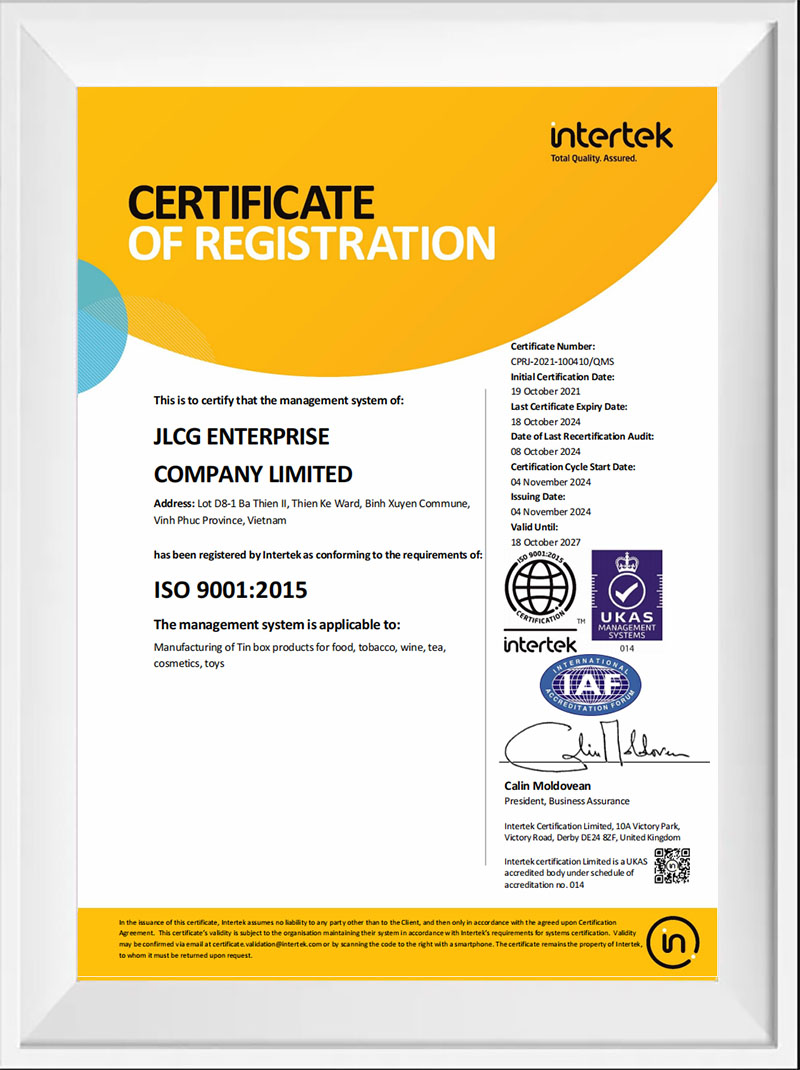
JLCG Enterprise Co.,Ltd is a tin box manufacturer based in Vinh Phuc Province, Vietnam, producing and customising metal packaging for food, gifts, cosmetics and collectibles. The company has more than 25 years of experience in the industry, serves brands such as Wrigley, Mondelez, BAT and Nestle, and holds ISO 9001:2015 certification for its quality management system. Its production covers custom design, shape and printing — which is exactly where gauge decisions sit in practice, set jointly by the brand's structural requirement and the material and tooling the factory will run.
What Tinplate Gauge Controls in a Cosmetics Tin Box
Gauge influences six practical properties for cosmetics packaging. It is easier to treat each as a separate requirement and reconcile them at the end than to search for a single correct gauge.
Panel rigidity and shape retention
Thicker tinplate resists bending and twisting more than thinner tinplate. Large flat surfaces — a palette lid, a wide rectangular gift tin — deflect more easily at a given thickness because the unsupported span is longer. Where the brand design depends on large flat areas, gauge and panel geometry have to be decided together: beads, recessed panels, stepped edges and wire edges all change how much rigidity a given thickness delivers.
Dent resistance through handling and transit
A cosmetics tin is handled many times between the factory and the consumer: packing, container loading, distribution, shelf placement and, for compact formats, pocket or handbag use. Dent resistance depends on thickness and on the area of unsupported panel. Heavier gauge generally absorbs more impact before permanent deformation; lighter gauge reduces weight and shifts more of the protection burden onto the carton and transit packaging.
Stackability and pallet performance
Stackability is a load case rather than a property. The bottom tin in a stack carries the weight of everything above it, and that load passes through the lid and rim. Thicker material reduces the risk of lid deflection and rim rolling. When the stack height or pallet pattern is aggressive for the chosen thickness, the box — not the carton — becomes the limiting factor. Buyers should state expected stack height and pallet configuration instead of assuming the supplier knows them.
Lid fit, closure integrity and moisture protection
Snap lids, slip lids, hinged lids and double-wire constructions all depend on rim geometry holding its shape. Airtight and moisture-proof requirements assume the lid-to-body interface stays in contact around the full perimeter after handling. Thinner material deforms more easily at the rim, which can open small gaps; heavier material holds the fit better but also changes the effort needed to open and close the box, which affects how the packaging is perceived in use.
Embossing, debossing and surface definition
Embossed brand marks, debossed logos and textured surfaces are formed by displacing metal. Material that is too thin does not hold deep relief and can distort around sharp tooling edges; material that is thicker forms cleaner relief but demands more forming force and tighter tooling control. Achievable depth is therefore a joint decision between artwork, tooling and gauge, and it is normally confirmed on a physical proof rather than agreed on paper.
Weight, freight and material efficiency
Gauge is a weight decision as well as a structural one. Every step up in thickness adds metal across the whole surface of the box, including lid, base and any inner tray. In an export programme where freight is calculated on weight and volume, an unnecessary gauge step is paid for on every shipment, not once. Conversely, saving material on a format that dents in distribution usually costs more in replacements and claims than it saves at the factory gate.
Forming behaviour and repeatability
Different gauges form differently. Tight radii, deep draws, wire edges and partitioned inserts each have a working range; when thickness changes, forming settings, pressure and sometimes the tooling itself must change. That is why a gauge change requested after tooling approval is not a paper change, and why the specification should be frozen before tools are cut.
How JLCG approaches gauge in production
JLCG Enterprise Co.,Ltd offers full customisation of design, shape and printing, and works with tinplate selected for strength and flexibility rather than a single default substrate. Production is governed by documented quality control processes intended to meet international standards, and the company holds ISO 9001:2015 certification — a documented quality management system is what makes a stated thickness repeatable from the approved sample through mass production. The company also prioritises eco-friendly manufacturing in material sourcing and waste management, which matters when a brand chooses reusable metal packaging as part of its sustainability positioning.
Step-by-Step: Building a Gauge Specification You Can Hand to a Supplier
The sequence below converts a brand requirement into a specification that can be quoted, sampled and inspected. It can be completed before a supplier is selected, which is what makes competing quotations comparable.
- Profile the contents. Record the product, its weight, its dimensions and whether it sits loose, in a tray, in a pouch or in a partitioned insert. Fill weight and weight distribution set the load the box has to carry.
- Define the handling journey. List everything between filling and the consumer: cartoning, palletising, stack height, sea or air freight, retail handling, e-commerce parcel handling. Each stage is a load case the gauge has to survive.
- Separate the structural roles. Decide which parts carry load (base, rim, lid), which parts are decorative, and whether internal parts can use a different thickness from the outer shell. Multi-piece boxes rarely need uniform gauge.
- Agree the decoration plan. State which elements are printed and which are embossed or debossed, and how deep the relief should read. Depth targets should be confirmed as feasible in the chosen gauge during sampling.
- Ask for thickness in millimetres, not only gauge. Require every quotation to state the nominal thickness in millimetres, the tolerance and the gauge table referenced. This single change makes quotes comparable and inspectable.
- Sample and test against the load cases. Evaluate prototypes at the stack height, compression and drop conditions expected in the field, then check lid fit over repeated open and close cycles, dent resistance and embossing definition. Record what passes, because that record becomes the acceptance criterion.
- Freeze the specification before tooling. Once tools are cut for a thickness, a change means changes in the forming set-up. Lock substrate, coating, thickness and tolerance in the approved sample.
- Set change control. Require written notification if material, coating or thickness changes, and re-approval of the sample if it does. Gauge drift is one of the few packaging changes a buyer cannot see from the outside.
The table below shows the minimum handoff information for a cosmetics tin box project.
| Specification field | What to state | Why it matters |
|---|---|---|
| Product and fill | Product type, fill weight, dimensions, whether a tray or insert is used | Sets the load the box must carry and the risk if it deforms |
| Box format | Shape, external dimensions, single-piece or multi-piece construction | Determines panel span and where rigidity is needed |
| Nominal thickness | Millimetres plus gauge reference plus tolerance | Makes quotations comparable and production inspectable |
| Substrate and coating | Tinplate grade and the coating on the product-contact surface | Needed for material declarations and for the destination market's requirements |
| Structural requirement | Stack height and orientation, compression and drop expectations | Converts a general requirement for sturdiness into something a supplier can engineer against |
| Closure type | Snap lid, slip lid, hinged lid or double-wire construction | Rim geometry and gauge interact in every closure design |
| Decoration | Printed areas, embossed or debossed elements, target relief depth | Depth feasibility is gauge-dependent and must be proved on a sample |
| Verification | Sample approval criteria and inspection record at production | Keeps the approved sample and mass production aligned |
Practical Use Cases: Gauge Decisions by Cosmetics Format
Lipstick and lip balm tins
Small-diameter formats place the highest demand on rim accuracy and lid fit rather than on large-panel stiffness, because the panels themselves are small. The gauge still matters: a thin wall deforms easily at the rim, producing a lid that feels loose or fails to reseal. Print and embossing usually concentrate on the lid, so relief depth has to be proved in the same thickness that will run in production.
Eyeshadow and partitioned palettes
Palettes combine a large, mostly flat lid with internal partitions. Panel span makes the lid the weak point, and partitions need enough structural support to stay aligned when the box is opened and closed repeatedly. Buyers often solve this with a heavier profile, or with added geometry such as beads or a wire edge, rather than with thickness alone.
Travel-size and mini formats
These formats are governed by unit weight, nesting and freight efficiency, which favour lighter profiles. The counterweight is handling: airline, parcel and retail distribution can be hard on small tins. The practical approach is to select the lightest profile that still passes the compression and drop conditions the format will actually meet.
Gift sets and multi-piece presentations
Gift sets are stacked, displayed and often kept by the consumer, so the structural brief includes stackability, perceived quality and durability across repeated use. This is where heavier profiles and deep embossed branding usually justify their weight, and where the inner tray — which may need less thickness than the outer shell — can be specified separately.
Essential oil and airtight moisture-proof tins
When the packaging function is protection, the closure is the product. Gauge must support the rim geometry that keeps the lid in contact around the whole perimeter after transit, and the specification should be validated after handling, not only on a fresh sample. Re-testing after transit simulation is the difference between a moisture-proof claim and a moisture-proof box.
Gauge Profile Comparison for Cosmetics Tin Boxes
The comparison below describes relative behaviour of thin, mid-range and heavy tinplate profiles. It is a decision aid, not a thickness table: the nominal millimetre value behind each profile depends on the supplier's tooling and must be confirmed in the quotation.
| Aspect | Thin profile | Mid-range profile | Heavy profile |
|---|---|---|---|
| Relative material thickness | Lowest of the three | Middle band | Highest of the three |
| Panel rigidity | Low; large flat panels deflect easily | Moderate; suits moderate panel spans | High; suits large spans and wide lids |
| Dent resistance | Lowest; needs more protective transit packaging | Moderate; adequate for controlled distribution | Highest; tolerates rougher handling |
| Stackability | Suitable for low stacks | Suitable for moderate stacks | Best for tall stacks and dense pallets |
| Embossing and debossing | Shallow relief; distortion risk on sharp edges | Moderate relief with controlled tooling | Deep, well-defined relief |
| Unit weight and freight | Lowest material weight | Balanced | Highest material weight |
| Typical cosmetics fit | Small, lightly handled, cost-sensitive tins | General lip, balm and travel formats | Palettes, gift sets and reusable premium tins |
| Main risk if wrongly chosen | Dents, loose lids, weak branding relief | Acceptable in most cases; can be marginal at high stack heights | Unnecessary weight, cost and freight |
Two profiles can be correct for the same brand. A gift set may use a heavy outer box for shelf presence and a lighter inner tray that is only handled once, and a travel format may use a lighter shell with a reinforced rim. The decision is not which profile is better, but which profile matches the load cases, the branding method and the freight budget of each component.
Frequently Asked Questions
1. Which certifications and documents should I expect for a cosmetics tin box produced in Vietnam?
Start from the requirement rather than the certificate. Ask the supplier to document the tinplate grade and the coating that will come into contact with the product, and to confirm that these fit the material requirements of the market you sell into. Ask which quality management certification the factory operates under — JLCG Enterprise Co.,Ltd holds ISO 9001:2015 — and require the approved sample to record substrate and thickness so production can be checked against it. If retail or regulatory review will ask for material declarations, raise that before sampling, because the declaration has to match the material actually used.
2. Does a heavier tinplate gauge improve embossing on a cosmetics box?
Generally yes, within limits. Deep relief needs enough material to be displaced and to hold its shape, so very thin tinplate tends to produce shallow embossing and can distort around sharp tooling edges. Thicker material, however, demands more forming force and tighter tooling control, and it changes lid fit and the effort required to open the box. The practical route is to define the relief depth the brand wants and have the supplier confirm it on a physical proof in the candidate gauge.
3. How does gauge choice affect the cost of a cosmetics tin box programme?
It affects both unit cost and logistics cost. Thicker tinplate uses more metal in the lid, body and any inner tray, and adds weight that is paid for on every shipment. Thinner material reduces both but shifts risk into transit: a box that dents, or whose lid deforms in distribution, generates replacements and claims. The useful comparison is total landed cost at a defined stack height and transit profile, with every supplier quoting the same millimetre thickness.
4. Can I test different gauges before committing to production?
Yes, and for a first project it is the most reliable way to settle the specification. Request prototypes in the candidate thicknesses and evaluate them against real conditions: stack to your planned height, run a compression or drop check, open and close the lid repeatedly, and inspect embossed areas under retail lighting. JLCG Enterprise Co.,Ltd offers full customisation of design, shape and printing, so samples can be produced in the intended format and decoration before tooling is finalised.
5. Does gauge selection affect lead time?
Gauge mainly affects lead time through tooling and material planning. If thickness is fixed before tooling is cut, the schedule follows the normal path; if it changes after tooling approval, forming set-ups — and sometimes the tooling itself — must be reworked and the approved sample repeated. The control point is sample approval: finalise thickness there, then confirm the production schedule against that frozen specification. JLCG Enterprise Co.,Ltd plans production and logistics around on-time delivery, and can confirm gauge options, samples and timing for a specific cosmetics project on request — contact www.vntinbox.com, sales06@vntinbox.com or +86 18819080997 (phone / WhatsApp / WeChat).
Conclusion
Tinplate gauge is a structural decision that is usually treated as a purchasing detail. In a cosmetics tin box, it determines how much the panels flex, how well the box resists dents, how high it can be stacked, whether the closure stays in contact in transit, and how deep an embossed brand mark will read. Getting it wrong is expensive in both directions: too light and the box fails in distribution, too heavy and the brand pays for metal and freight it never needed.
The framework is straightforward. Define the load cases, separate the structural roles inside the box, agree the decoration depth, ask for thickness in millimetres alongside the gauge reference, validate on a sample against real handling conditions, and freeze the specification before tooling. Any supplier can then be measured against the same specification, which is what makes quotations comparable in the first place.
For buyers sourcing cosmetics tin boxes from Vietnam, JLCG Enterprise Co.,Ltd produces custom tin boxes from its facility at Lot D8-1 Ba Thien II Industrial Park, Thien Ke Commune, Binh Xuyen District, Vinh Phuc Province, Vietnam, with full customisation of design, shape and printing and documented quality control under ISO 9001:2015.
Request Gauge Samples and a Quotation
Send your box format, fill weight and stack height, and JLCG Enterprise Co.,Ltd will confirm gauge options, sample timing and pricing for your cosmetics tin box project.
Website: www.vntinbox.com
Email: sales06@vntinbox.com
Phone / WhatsApp / WeChat: +86 18819080997
Have Questions or Need More Details?
Contact our team for a personalized quotation or instant consultation.
Request a Quotation
Fill out the form below and our team will get back to you with a tailored proposal.
WhatsApp Direct Chat
Prefer to chat in real-time? Message us on WhatsApp for instant assistance & quick answers.
- Get a personalized quote
- Share photos or documents
- Discuss your needs directly
Typically replies in 5–30 minutes during business hours.