How to Avoid Vietnam Cosmetics Tin Box Sourcing Risks
How to Avoid Vietnam Cosmetics Tin Box Sourcing Risks
The difference between a smooth Vietnam cosmetics tin box project and a costly one is usually not the price of the tin. It is how carefully you verify the supplier, lock the specification, and agree on risk controls before production begins.
The Procurement Risks Hidden Behind a Vietnam Tin Box Inquiry
Most buyers do not fail because they chose the wrong tinplate or the wrong print finish. They fail because they make decisions based on assumptions that were never verified. A quotation can look professional. A website can look complete. A sample can look attractive. The risk in Vietnam cosmetics tin box sourcing is what happens after those first impressions.
The most frequent risk patterns in this type of packaging project include:
- A supplier claims to be a factory but is only a trading office or an intermediary.
- A pre-production sample is approved, but mass production uses different material thickness, printing quality, or tooling conditions.
- The buyer specifies only the outer size and does not define tolerances, partition structure, product fit, or inner packing.
- The supplier mentions certifications, but the buyer never verifies the certificate scope or the issuing body.
- The quotation covers only the bare box, leaving tooling, artwork, inner trays, cartons, and logistics to appear later as extra costs.
- The supplier cannot show evidence of complex custom shapes, so an unusual lipstick case or eyeshadow tin design becomes a hidden engineering risk.
These problems are manageable. They cannot be solved by asking one more question. They are solved by applying a stage-by-stage risk-control system that covers verification, specification, sampling, production, and delivery.
Why Vietnam Has Become a Practical Supply Base for Metal Cosmetics Packaging
Vietnam has become a practical sourcing location for metal packaging in the Asia-Pacific region. Its geographic position works well for buyers serving Asian, European, and North American markets, and its industrial base now includes manufacturers with experience in food tins, tea and coffee tins, confectionery tins, health-care tins, candle tins, and cosmetics tins.
That cross-industry experience matters. Cosmetic tin box buyers are not asking a supplier to learn metal packaging from scratch. They should be asking whether the supplier already controls the same production steps that a demanding cosmetics project requires: printing, coating, forming, edge finishing, internal fitting, and quality inspection.
JLCG Enterprise Co.,Ltd is an example of a Vietnam tin box manufacturer with this kind of visible production range. The company designs and produces metal packaging for food, gifts, cosmetics, and collectibles. It reports more than 25 years of experience in the industry and lists international consumer-goods brands such as Wrigley, Mondelez, BAT, and Nestle among its customer references. The company is based at Lot D8-1 Ba Thien II Industrial Park, Thien Ke Commune, Binh Xuyen District, Vinh Phuc Province, Vietnam.
None of these facts remove the need for buyer-side verification. They do show that when procurement risk is managed well, the Vietnam supply base already contains manufacturers with credible, verifiable production histories.
The 6-Stage Risk-Control Framework for Sourcing Vietnam Cosmetics Tin Boxes
The following framework is designed for importers, brand owners, private-label companies, and procurement teams that need to move from inquiry to bulk production with fewer surprises.
Stage 1: Verify the Supplier Behind the Website
Start with the legal entity and the production address. A risk-control process cannot begin with sampling. It must begin with verification of who will actually manufacture your order.
Ask for the full company name, the factory address, the certification evidence, and product examples that match your category. Then cross-check what was provided. For example, JLCG Enterprise Co.,Ltd publishes its factory address as Lot D8-1 Ba Thien II Industrial Park, Thien Ke Commune, Binh Xuyen District, Vinh Phuc Province, Vietnam. This kind of address clarity is useful because it can be checked against registrations, shipping documents, or a future factory audit.
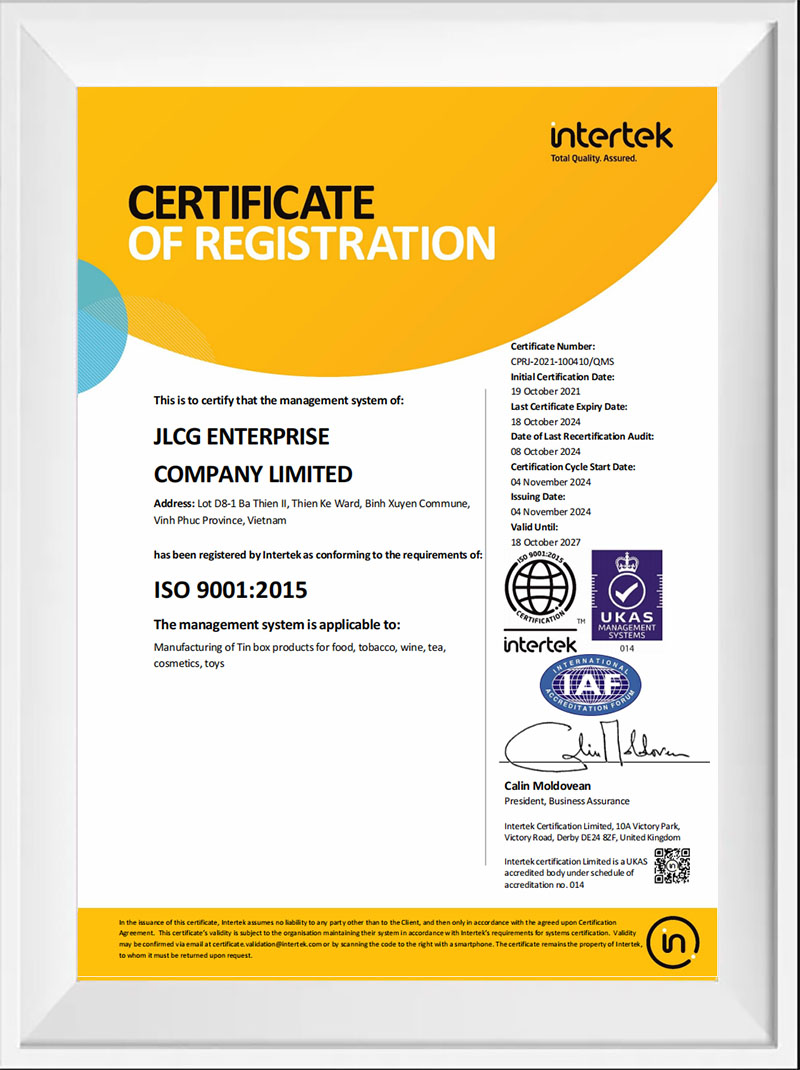
Certification is another verification layer. JLCG holds ISO 9001:2015 certification, which is a recognized quality management system certification. The certificate allows a buyer to ask more specific questions about documented procedures, corrective action, and inspection records. ISO 9001 is not a product certificate, but it is a meaningful starting point for evaluating a factory's internal discipline.
Stage 2: Match the Supplier Capability to Your Product Category
Not every tin box factory can execute every cosmetics packaging structure. A plan lipstick tin is not the same as a rigid eyeshadow palette case, and a gift tin with internal partitions is not the same as a simple slide-lid box.
Ask what product categories the factory produces. JLCG shows tin boxes for confectionery, cosmetics, health care, tea and coffee, and spirits. This range matters because it indicates experience with different printing, coating, and structural requirements. For cosmetics, buyers should also discuss whether the supplier can meet needs such as custom size, custom logo, partition structures, and moisture protection.
Do not assume that a manufacturer of tea tins can automatically produce a premium cosmetics tin. Use the product range as evidence, then move to drawings and samples for your specific structure.
Stage 3: Lock the Specification Before You Talk About Price
Price discussions become risky when the specification is unclear. Every Vietnam cosmetics tin box order should have a written specification that includes external dimensions, material grade and thickness, printing colours, logo placement, decoration method, coating or lacquer requirements, inner partitions, cushioning, carton packing, and target fill weight where relevant.
When the specification is ambiguous, every later problem becomes a negotiation. When it is written, the factory can quote the same scope that the buyer expects to receive.
Custom-size and custom-logo projects should be documented with drawings or artwork proofs. A detailed specification is not bureaucracy. It is the contract between your brand expectations and the factory's production plan.
Stage 4: Treat the Sample as a Production Rehearsal
A sample is not a marketing artifact. It is the first chance to verify whether the production process can deliver your design. Check dimensions, opening and closing, edge smoothness, printing accuracy, colour coverage, and consistency between multiple sample pieces rather than a single perfect unit.
Place your actual cosmetic product inside the tin. A lipstick should sit correctly. An eyeshadow palette should fit inside the internal tray without rattling. An essential oil bottle should not move during transit. If the tin is intended to protect against moisture, confirm that the lid creates the expected seal.
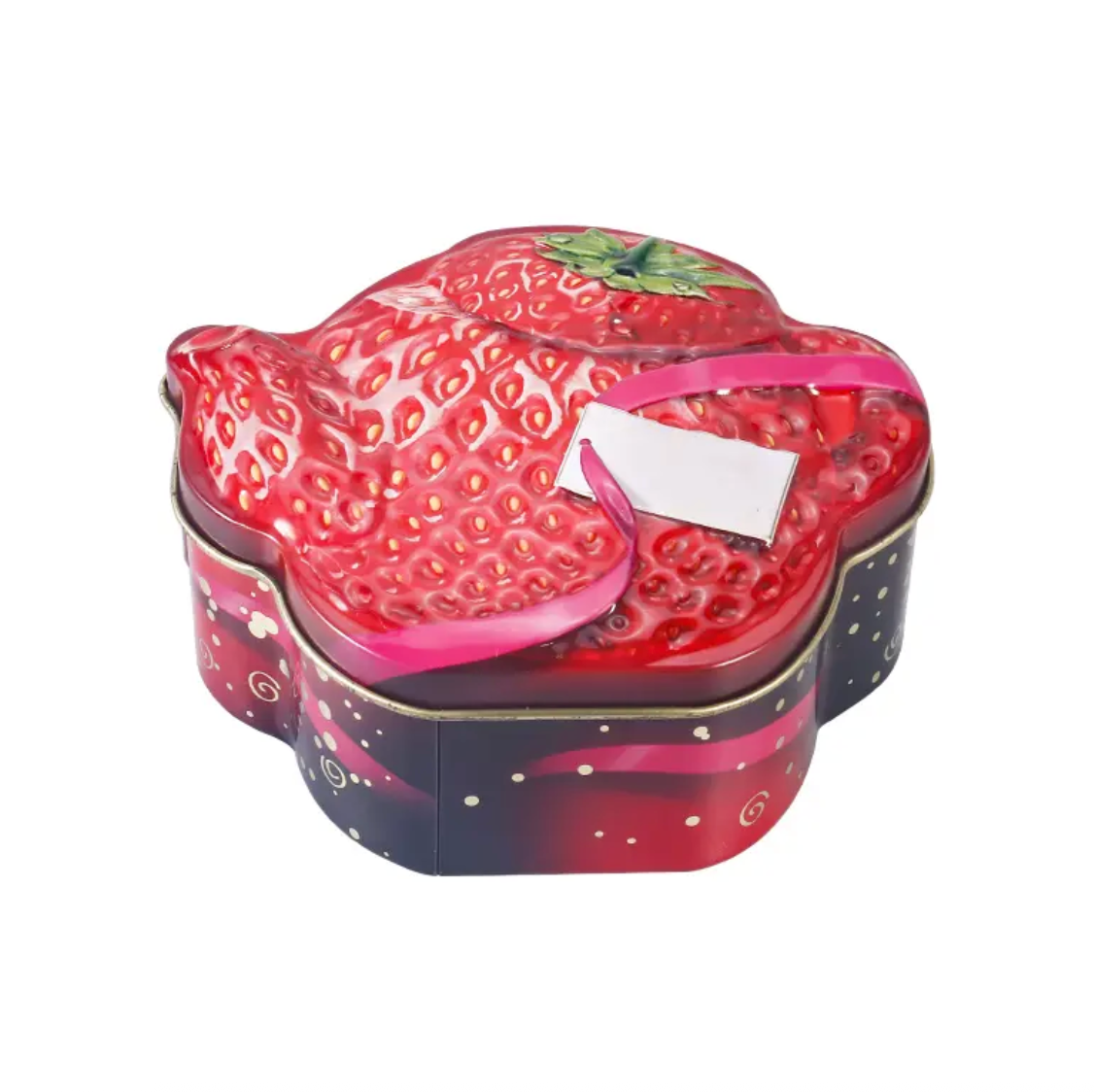
Sampling also becomes a test of engineering confidence. JLCG has shown custom-shape work such as a teapot-shaped tin box for tea. That type of project is visible evidence that the factory has tooling experience beyond simple round and square shapes. For unusual cosmetics structures, this kind of evidence is more valuable than a verbal promise.
Stage 5: Put Acceptance Criteria into the Purchase Agreement
Before mass production starts, agree on how the finished goods will be checked. Define what is acceptable, what is rejectable, and what happens if a defect is found after shipment.
Common buyer controls include checking the percentage of defective units, running an inline inspection during high-volume production, completing a pre-shipment inspection, and approving photographs or reports. A supplier with a certified quality management system, such as JLCG's ISO 9001:2015 system, should be able to provide documented quality procedures and inspection records. If a supplier avoids acceptance criteria, consider that a risk signal rather than a sign of flexibility.
Stage 6: Plan the Lead Time and Logistics Buffer
Cosmetics tin box projects depend on a chain of steps: artwork confirmation, tooling if required, material ordering, printing, forming, assembly, packing, inspection, and shipment. Any of these steps can affect the final delivery date.
Ask the supplier for a written project timeline. Name each milestone and request confirmation of how delays will be communicated. JLCG lists on-time delivery as a company commitment, but a professional buyer should still build a buffer into their own schedule, especially when the order is seasonal or linked to a product launch.
A Short Risk-Control Procurement Checklist for Cosmetic Tin Boxes
The framework above can be compressed into a practical checklist for every Vietnam cosmetics tin box inquiry.
- Verify the factory name and physical address. Do not rely only on a website or a brochure.
- Request certification evidence and check whether the certificate is relevant to your product category.
- Ask which product families the factory manufactures today and compare them with your packaging structure.
- Send a written specification with dimensions, tolerances, material expectations, printing requirements, and packing details.
- Request a complete quotation that separates the box price from tooling, artwork, sample charges, inner packing, cartons, and logistics.
- Ask for the minimum order quantity and the lead time for each project phase.
- Require a pre-production sample built from production-representative tooling or printing conditions.
- Place your actual cosmetic product inside the sample and test fit, opening, closure, and protection.
- Agree on an inspection and acceptance procedure before mass production starts.
- Confirm how the factory will handle defective goods and late delivery.
Putting the Framework to Work: Cosmetic Product Use Cases
Different cosmetics formats create different sourcing demands. The same framework applies to every format, but the priority checks change.
Lipstick and Lip Balm Tins
Lipstick and lip balm projects often need small, pocket-friendly tins. Buyers should focus on lid fit, closure security, and the precision of the custom logo printing. Travel-size cosmetics tin boxes also require light protection so that users can carry them in bags without accidental opening.
Eyeshadow and Pressed Powder Tins
Eyeshadow and pressed powder products usually need flat tins with enough internal depth to protect formula pans. Partitioned storage Vietnam cosmetics tin boxes are relevant here. The supplier should be able to create internal dividers or trays that hold the pans in place during handling and shipping.
Gift Set and Limited Edition Tins
Gift sets combine visual appeal with product protection. Buyers often need custom shape, custom size, custom logo, and coordinated inserts. For this use case, engineering flexibility is more important than the lowest unit price, because the packaging itself becomes part of the brand experience.
Essential Oil and Balm Tins
Essential oil and balm packaging often requires airtight, moisture-proof performance. Buyers should evaluate the seal, the inner surface coating, and how the tin handles repeated opening and closing. A simple decorative tin may not be enough for products that are sensitive to air or humidity. Vietnam essential oil cosmetics tin boxes should be specified with protection requirements in the same way as any technical packaging.
Evidence Comparison: What a Strong Vietnam Supplier Shows vs. What the Buyer Must Control
The most useful comparison in a sourcing process is not only between different brands. It is between the evidence a supplier presents and the controls the buyer keeps in the contract. The table below shows both sides of that comparison.
| Procurement Area | Strong Supplier Evidence | Buyer-Side Control |
|---|---|---|
| Manufacturing Presence | Full factory name and physical address that can be checked against documentation. | Confirm the legal entity before making payments or signing documents. |
| Quality System | Visible certification such as ISO 9001:2015 with a defined management scope. | Ask how inspections, defects, and corrective actions are documented. |
| Custom Capability | Product range that includes cosmetics, health care, food, tea, coffee, or other demanding metal packaging categories. | Require drawings and samples for your specific custom size, shape, or logo layout. |
| Cost Transparency | A quotation that clearly separates tooling, printing, packing, and logistics. | Define the scope in writing and reject vague all-in pricing without a breakdown. |
| Delivery Reliability | A stated commitment to on-time delivery supported by a visible production process. | Require a dated milestone schedule and agree on communication rules for delays. |
This comparison is not designed to remove trust from the relationship. It is designed to make trust verifiable. Buyers who have strong evidence and strong contract controls can work with a factory more efficiently, because both sides understand the same rules.
Frequently Asked Questions on Vietnam Cosmetics Tin Box Sourcing and Risk Control
What certifications should I check when sourcing Vietnam cosmetics tin boxes?
Certifications should be tied to a documented quality system. ISO 9001:2015 is the certification visible at JLCG Enterprise Co.,Ltd. Buyers should request the certificate and confirm the company name and scope. ISO 9001 confirms a quality management system; it is not a product-specific compliance certificate.
Can a Vietnamese tin box supplier make custom shapes and sizes for cosmetics?
Customisation is possible when the supplier has engineering and tooling capacity. JLCG Enterprise Co.,Ltd offers custom design, shape, and printing. Its product range includes a teapot-shaped tin box for tea, which is an example of non-standard structural work. For cosmetics, custom size, custom logo, and internal partitions should be confirmed through drawings and samples before production.
What cost items should be included in a Vietnam cosmetics tin box quotation?
Compare total procurement scope, including material specifications, printing, tooling if required, inner packaging, carton packing, sample charges, logistics, and payment terms. A low unit price may be misleading if the order scope excludes tooling, packing, or later rework.
How should I evaluate a pre-production tin box sample?
Check dimensions, printing registration and colour, opening and closing, surface defects, product fit, and sealing if the product needs moisture protection. Place your actual cosmetic inside the sample and test how it sits, how it opens, and how it survives repeated handling. The sample should be produced under the same printing and tooling conditions expected for mass production.
What lead time should I plan for a custom cosmetics tin box project?
The right lead time depends on the design, tooling or printing preparation, sample approval, production quantity, and shipping route. Ask the supplier for a dated schedule that includes each milestone. Project-specific timelines are more useful than a general estimate. JLCG states on-time delivery as a company commitment, but a buyer should still confirm the schedule before placing an order.
Next Step: Move from Risk Control to a Verified Project Plan
Every Vietnam cosmetics tin box project becomes easier when the supplier is verifiable, the specification is clear, and the timeline is written. If you are evaluating a custom packaging project, start by requesting a quotation that matches your product specification.
Contact JLCG Enterprise Co.,Ltd for a project-specific conversation about samples, tooling, custom design, printing, and delivery planning.
Email: sales06@vntinbox.com
Phone / WhatsApp / WeChat: +86 18819080997
Website: https://www.vntinbox.com/
Factory: Lot D8-1 Ba Thien II Industrial Park, Thien Ke Commune, Binh Xuyen District, Vinh Phuc Province, Vietnam
Have Questions or Need More Details?
Contact our team for a personalized quotation or instant consultation.
Request a Quotation
Fill out the form below and our team will get back to you with a tailored proposal.
WhatsApp Direct Chat
Prefer to chat in real-time? Message us on WhatsApp for instant assistance & quick answers.
- Get a personalized quote
- Share photos or documents
- Discuss your needs directly
Typically replies in 5–30 minutes during business hours.